.png)
You've talked about succession. Or selling. Or buying out a partner. A valuation got done. The CPA modeled a few scenarios. The estate attorney drafted something. An M&A attorney or broker took a first look at a sale. The banker looked at financing. The family met, maybe more than once.
Then the process slowed. A few months later it started up again with a new idea and a new advisor, and then it paused again.
If that has gone on for a year or more, the usual conclusion is that you haven't found the right solution yet. That is probably the wrong conclusion. More likely, you're trying to solve a decision problem with technical solutions.
Lawyers, CPAs, bankers, and brokers are very good at answering a question once the owners are clear about what they want. They can't produce that clarity by generating more structures, models, and options. When the owners have different goals, different timelines, or haven't settled which decision comes first, more technical work gives you the same result: start, stop, reconsider, restart.
Activity is not progress. If a transition keeps stalling, another technical solution may not be what is missing. The owners may still need help making the decision the technical work depends on.
More expertise won't fix it
When a transition stalls, it tends to attract more expertise. That's understandable. If the plan isn't moving, maybe it needs another opinion.
But expertise only works on the problem it was built for.
- An M&A attorney can paper a buyout, but can't make a partner who doesn't want to sell agree to it.
- A tax lawyer can't resolve whether two siblings want different futures for the business.
- A banker can't decide whether the senior generation should take liquidity now or leave capital in for growth.
- A broker can't settle whether the owners actually want to sell.
- An estate planning structure can't answer whether the next generation should own together.
Those decisions have to be surfaced and worked through first. That doesn't diminish the specialists. It's what lets their work hold.
Most advisors are engaged to solve a defined problem. A transition crosses more than one.
Almost every professional model works the same way. Someone is the client, the client decides, and the professional builds around that decision. The estate attorney drafts for the owner. The M&A attorney papers the deal the sellers want. The broker markets the business on the owner's instructions. The banker structures financing for the borrower. That works when one voice speaks for the business.
A succession, sale, or buyout in a family business rarely has one voice. It touches co-owners, children who work in the business and children who don't, a spouse, key managers, and future owners who may not yet have a formal role. Their views matter, and in most families no one has ever helped them say those views out loud, let alone reconcile them.
So each advisor works for whoever hired them. The work is technically sound, then someone it affects pushes back, a co-owner won't sign, or a sibling objects, and everything stops.
You can't plan a transition for the people in it. You have to plan it with them.
What has to happen before the technical work
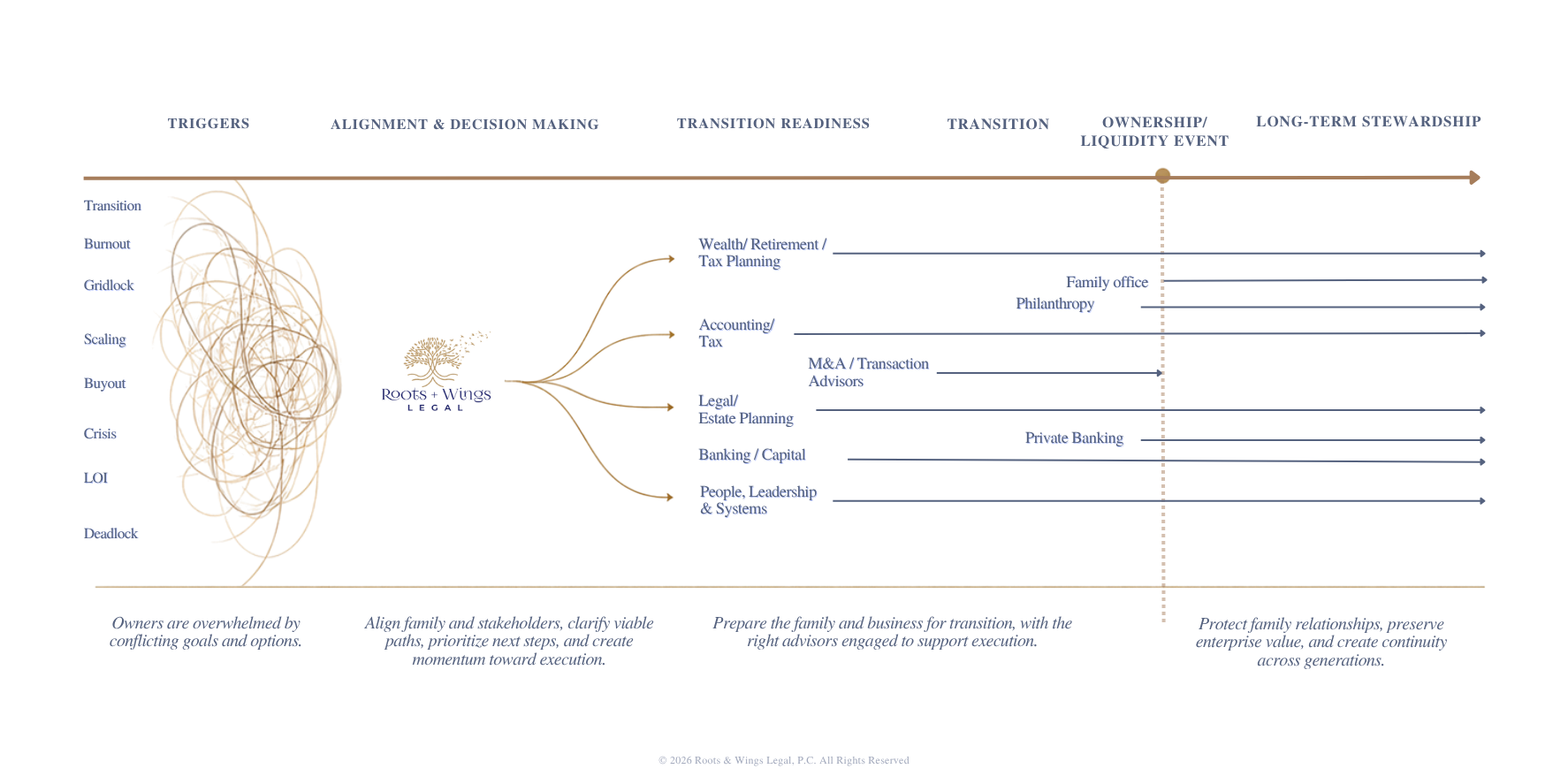
Most planning diagrams skip this part. Before legal, tax, and banking work can do its job effectively, the owners and the people affected need to work through some questions:
- What are we actually trying to accomplish?
- Where do our goals and timelines differ?
- Which decisions have to be made now, and which can wait?
- Which options are genuinely viable, and what tradeoffs are we willing to accept?
- Who needs to be part of which decision?
A transition can start with a trigger: succession, burnout, a buyout, a crisis, a deadlock, an unsolicited offer. But the next step isn't automatically drafting documents or lining up financing. It's alignment and decision-making. Then transition readiness. From there, the technical specialists can work around a direction the owners have actually chosen.
Are you stalled?
- It's been more than a year since the first serious conversation, and nothing has been implemented.
- Each advisor has heard a slightly different version of the goal.
- One owner is thinking about a sale, another about the next generation, and they haven't told each other.
- Documents get drafted, circulated, and then sit.
- The timeline keeps moving to "after the busy season."
- The newest idea gets the most attention in the room.
- People who will be affected haven't been asked what they want.
If several of these sound familiar, the work may need to move upstream.
Not sure where your stall is? Take the 7-Question Transition Assessment →
"When we encountered roadblocks, she offered creative alternatives that kept the transaction moving forward."
Tony Selko, Partner at Backen & Backen
Waiting isn't neutral
Indecision is a decision. It feels like keeping your options open, but every year some of them close. A buyer loses interest or gets acquired. A key manager takes another job. A child who might have stepped in builds a life elsewhere. A partner's health changes. The market turns, or the tax rules do.
Eventually what's left is whatever circumstances allow. Then a consequential ownership decision gets made under pressure, without the family having had the opportunity to work through what each person wanted.
Where we come in
Roots & Wings Legal is Enterprise Counsel for business-owning families. When the path isn't clear, we start upstream with Family Business Advisory. We talk with each person individually, then facilitate the conversation as a group, often in a retreat. Not every wish gets adopted, but you need to know what people want to decide well. The result is a roadmap: the decisions, the order, and who has to be involved.
Then the build begins, and it rarely belongs to one advisor. That's the role of Enterprise Counsel: holding the whole plan and keeping it in sequence across your lawyer, CPA, banker, and wealth advisor. Think of an architect and a general contractor. The architect designs with the people who will live in the building. The contractor makes sure it gets built right, across every trade.
We’ve worked on these transitions from the deal side too. When a matter stalls, the documents are often not the real problem.
If your process keeps stopping, start with the decision, not another solution. Take the 7-Question Transition Assessment → We'll help you decide while you still have options.